Ablative vs Non-Ablative Laser Resurfacing: Which One Do You Actually Need?
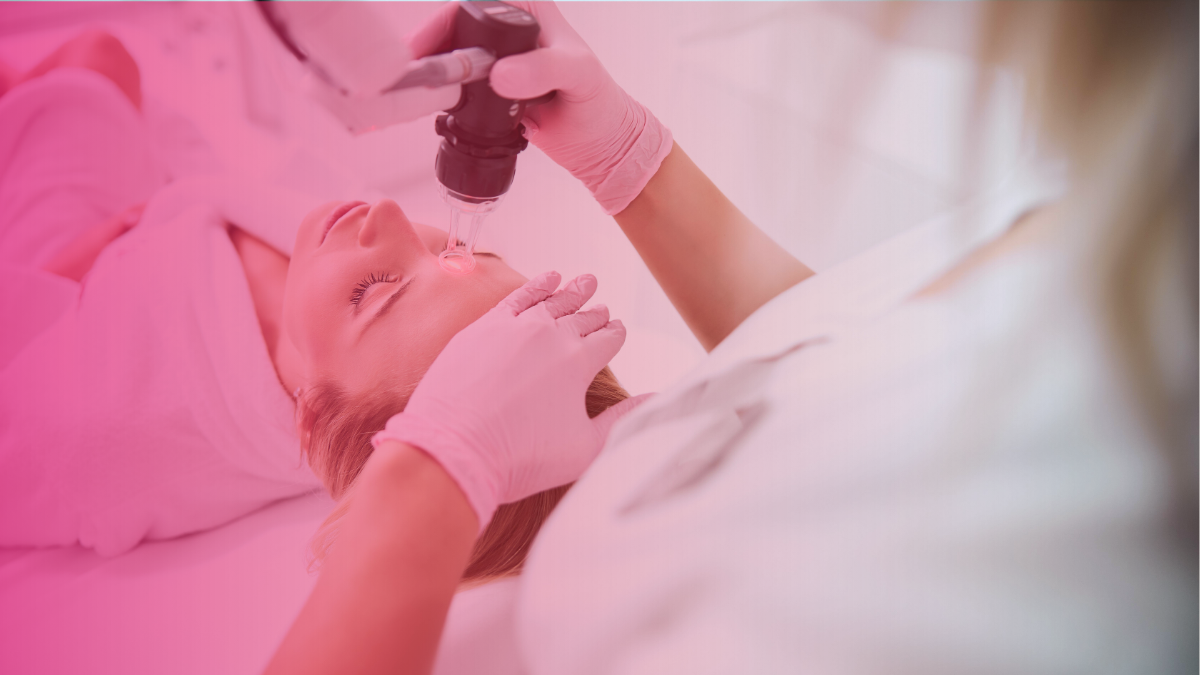
Minimal downtime is the most common thing people ask for when they start researching laser resurfacing, and it is also the request most likely to end in disappointment. The reason is not that gentler lasers are bad, because they are legitimately useful. The reason is that the trade-off is rarely explained, so patients buy a course of treatments that was never capable of reaching the result they had in mind.
The honest version is that the amount of change you see tracks the amount of tissue disruption you accept. A treatment with no downtime produces a small change per session. A treatment with a week of downtime produces a large one. Everything else in this category is a variation on where you want to sit along that line.
What is the difference between ablative and non-ablative laser resurfacing?
Ablative lasers remove tissue. They vaporize the outer layer of skin and force it to regenerate, which creates a genuine wound and a genuine recovery in exchange for a larger change. These devices run at 10,600 nm in the case of CO2, or 2940 nm in the case of erbium.
Prices vary by location and provider.
Non-ablative lasers leave the surface intact. They heat columns of tissue beneath the epidermis to provoke collagen remodeling without creating an open wound, which means less change per session, very little downtime, and more sessions to reach a given endpoint.
Almost everything else in this category, including the device names, the marketing language, and the price differences, follows from that one distinction.
Which concerns does each type actually treat?
| Non-ablative | Ablative | |
|---|---|---|
| Tone, dullness, mild pigment | Good | Very good |
| Fine lines | Modest, cumulative | Good |
| Deep, etched wrinkles | Limited | Best available without surgery |
| Moderate to severe acne scarring | Partial, over many sessions | Best available |
| Texture and pore appearance | Good | Very good |
| Sagging or laxity | No | No |
The short version is that non-ablative resurfacing delivers gradual improvement and maintenance, while ablative resurfacing delivers correction. Both are legitimate, and they answer different questions.
Worth noting that neither one lifts. Heat tightens marginally, but if your concern is jowls or a softening jawline, resurfacing is not the answer regardless of which type you choose, and a provider who suggests otherwise is selling the wrong treatment. Laxity belongs to a different category entirely, whether that is an energy-based tightening device or surgery.
Resurfacing also does not stop pigment from returning. Melasma in particular is a chronic condition driven by hormones and sun exposure, and while laser treatment can improve it, it recurs without ongoing sun protection and topical maintenance. Patients who treat melasma as a one-time fix are usually disappointed within a year.
Should you choose CO2 or erbium?
Both are ablative. The difference is how strongly the wavelength is absorbed by water. Erbium at 2940 nm is absorbed roughly ten to fifteen times more strongly than CO2, which means it deposits its energy in a very thin layer and leaves less residual heat behind.
| CO2 | Erbium | |
|---|---|---|
| Precision | Less precise, more thermal spread | Very precise, minimal spread |
| Collagen tightening | Greater, driven by heat | Less |
| Healing | Slower | Faster |
| Lingering redness | Weeks to months | Shorter |
| Pigment risk on deeper skin | Higher | Lower |
Erbium is genuinely gentler with less downtime, and the trade-off is real, because you give up the thermal collagen contraction that makes CO2 stronger on deep wrinkles. Erbium generally needs more sessions to approach a comparable result.
One nuance matters here. Modern long-pulsed erbium systems deliberately add some heat back, which narrows the gap considerably. The claim that erbium is always gentler is a simplification that depends far more on how the device is configured than on the wavelength itself.
Where do the named devices actually sit?
This is where marketing creates the most confusion, so here is the plain mapping.
| Device | Category | Downtime | Sessions |
|---|---|---|---|
| Clear + Brilliant | Non-ablative | Hours to 2 days | 4–6, then maintenance |
| Fraxel Dual | Non-ablative | 2–5 days | 3–5 |
| Mosaic 3D | Non-ablative | 1–3 days | 3–5 |
| Halo | Hybrid, both in one pass | 3–7 days | 1–3 |
| ProFractional | Ablative erbium | 3–5 days | 2–4 |
| Aerolase Era | Ablative erbium, superficial | ~48 hours | Varies |
| Fraxel re:pair | Ablative CO2 | 5–7+ days | 1–2 |
| Fractional CO2 | Ablative | 5–7+ days | 1–3 |
There are two traps worth knowing about before you sit down for a consultation.
Fraxel is a brand spanning both categories. Fraxel Dual is non-ablative. Fraxel re:pair is a CO2 laser and fully ablative. If you are quoted for "Fraxel," ask which one, because the downtime answer changes completely.
Aerolase Era is ablative, despite frequently appearing in minimal-downtime searches. It is a superficial erbium device with a very short pulse, so healing is quick, but it does not belong in the non-ablative category. Aerolase also makes the Neo Elite, which is non-ablative, and the two are often conflated.
Halo is a genuine hybrid, delivering a non-ablative and an ablative wavelength into the same treatment zone in a single pass. Because the ablative portion can be dialed down to nothing, how aggressive a Halo treatment turns out to be depends almost entirely on the settings the provider chooses. Two patients quoted for the same named treatment can receive very different treatments.
What does "minimal downtime" actually cost you?
The trade is close to linear.
- Clear + Brilliant gives near-zero downtime and a subtle change per session. It is real maintenance, meaning glow, refined texture, and mild pigment improvement.
- Fraxel Dual or Mosaic 3D involve a few days of flaking and produce meaningful cumulative improvement across three to five sessions.
- Halo takes under a week and approaches light ablative results in one to three sessions, which makes it the sweet spot for a lot of people.
- ProFractional or Era take three to five days and deliver real textural and scar improvement.
- Fractional CO2 takes five to seven days plus weeks of residual redness, and produces the strongest result in one to two sessions.
What you give up with the gentler options is depth. Non-ablative treatments cannot reach the level of dermal remodeling that significant acne scarring or etched wrinkles require, no matter how many sessions you buy. Someone with boxcar scars who books six Clear + Brilliant sessions will spend real money and end up disappointed, and that specific mismatch is one of the most expensive mistakes in this category.
How many sessions will you actually need?
The session counts in the table above are typical ranges rather than promises, and the honest answer for any individual depends on the starting point. Mild pigment and dullness respond faster than textural scarring. Deeper skin tones are usually treated more conservatively, which means more sessions at lower settings.
Two practical points are worth planning around. First, sessions are spaced, usually four to six weeks apart for non-ablative devices, so a course of five sessions is a project spanning five or six months rather than a single decision. Second, collagen remodeling continues for months after the final session, so the result at three months is not the final result. Patients who judge an ablative treatment at the four-week mark routinely conclude it did not work when the change was still developing.
Who is not a good candidate for laser resurfacing?
Active infection or inflammation in the treatment area needs to resolve first. A history of cold sores matters for treatments near the mouth, and providers commonly prescribe antiviral medication beforehand, because resurfacing can trigger an outbreak across freshly wounded skin.
Recent isotretinoin use generally requires a waiting period before ablative treatment, because the skin heals unpredictably, and the appropriate interval is a conversation for your prescriber and your provider. Pregnancy, a history of keloid scarring, certain autoimmune and connective tissue conditions, and recent sun exposure or a tan are all reasons to postpone or reconsider. Any medication that increases photosensitivity should be disclosed.
There is also a practical disqualifier that nobody enjoys hearing. If you cannot commit to strict sun avoidance and daily sun protection through the healing period, ablative resurfacing is a poor investment, because sun exposure on healing skin is the most reliable way to produce the pigmentation the treatment was meant to improve.
Ablative resurfacing creates a genuine open wound, so a few signs during healing warrant a prompt call rather than waiting for the scheduled follow-up. Spreading redness, warmth, swelling, yellow or green crusting, discharge, or a fever can all indicate infection, and infection on healing skin is the fastest route to scarring. Pain that climbs after the first two days rather than easing should be reported the same day, as should any area that turns white, grey, or unusually firm, or that blisters beyond what your provider described. Clustered blisters with tingling usually mean a cold sore has reactivated and needs antiviral treatment quickly. None of this is common in experienced hands, and every item on the list is far easier to manage in the first 48 hours than in the second week.
Is laser resurfacing safe for deeper skin tones?
Risk tracks melanin as a competing target, plus the total heat delivered. More surface disruption and more residual heat means more pigment activation, so the risk ranking follows thermal load rather than marketing claims.
Lower risk: 1064 nm Nd:YAG devices, which use the longest wavelength and are least absorbed by melanin, along with Clear + Brilliant at low energy and short-pulsed erbium at superficial settings.
Moderate, requiring experience and conservative settings: non-ablative 1550 nm devices such as Fraxel Dual and Mosaic 3D, and Halo at lower ablative settings.
Highest risk: aggressive fractional CO2, full-field CO2, and any high-density protocol regardless of the platform.
Five things genuinely help.
- A test spot is standard of care for Fitzpatrick IV through VI, rather than an inconvenience. Treat a discreet area, wait, and see what your skin does. A provider who declines to test spot is telling you something useful.
- Ask directly how many patients with your skin tone they have treated on this specific device, and ask to see their own results rather than stock photographs.
- Priming the skin beforehand with a topical regimen and strict sun protection is treated as standard practice for higher-risk skin, and experienced providers consider it one of the more useful levers they have against post-treatment pigmentation.
- Lower and slower beats aggressive. Two conservative sessions with a predictable result are a better deal than one aggressive session followed by a year of pigment correction.
- Be skeptical of "safe for all skin types" marketing. That phrase appears across the whole category. Devices have wider or narrower safety margins, and none of them removes the need for correct settings and an experienced operator.
The message is not that these treatments are off-limits for deeper skin. It is that the provider, rather than the device, is the variable that determines whether they go well.
Why is the per-session price the wrong number?
| Treatment | Per session | Sessions | Realistic total |
|---|---|---|---|
| Clear + Brilliant | from $300 | 4–6, recurring | $1,200–$1,800+ |
| Fraxel Dual | from $1,000 | 3–5 | $3,000–$5,000 |
| Halo | from $1,000 | 1–3 | $1,000–$3,000 |
| ProFractional | ~$1,000–$1,500 | 2–4 | $2,000–$6,000 |
| Fractional CO2 | from $2,000 | 1–3 | $2,000–$6,000 |
Clear + Brilliant looks like a fraction of the price of CO2 at first glance. A full course costs comparably to a single fractional CO2 session, and it does not reach the same endpoint. Non-ablative treatment is a different treatment billed in smaller increments rather than a budget version of ablative resurfacing.
Prices vary by market and by provider, and these are typical national ranges rather than fixed figures. Ask what the quote covers as well, since numbing, post-treatment products, and follow-up visits are bundled by some practices and billed separately by others. Package pricing for a full course is common and frequently unadvertised. The per-session price only means something once you know how many sessions you need and what result they lead to.
What should you ask before booking?
Ask which device and wavelength will be used, and whether it is ablative, non-ablative, or hybrid. Ask what depth and density the provider plans to use and why those settings suit your skin. Ask how many sessions your specific concern realistically needs, and whether the quoted price covers one session or the full course.
Ask how many patients with your skin tone the provider has treated on that device, and whether they will perform a test spot. Ask what your realistic downtime looks like rather than the best case, and ask who is operating the device, since in many practices that is not the physician you consulted with.
Finally, ask whether you are actually a candidate for resurfacing at all, or whether a different treatment would serve your concern better. The answer to that question is worth more than any discount.
Find providers near you
Compare real laser resurfacing prices from providers near you on the laser resurfacing cost guide, where practices publish what they actually charge so you can plan the full course rather than the first session. Get Clear Beauty lets you filter by location and budget before you book a consultation.
Compare Laser Resurfacing providers and estimated prices near you.
Laser Resurfacing cost guide →This article is for general education about aesthetic treatments and pricing. It is not medical advice and is not a substitute for a consultation with a licensed provider. Always confirm current pricing and suitability directly with a provider before booking.
New aesthetic treatment blogs every week, sent straight to your inbox.
Subscribe on Substack →
Comments
Comments are reviewed before they appear. For medical questions, please consult a licensed provider — we cannot give medical advice here.
Loading comments…