What Is PRF EZ Gel? A Clinician Explains the Natural Under-Eye Alternative to Filler
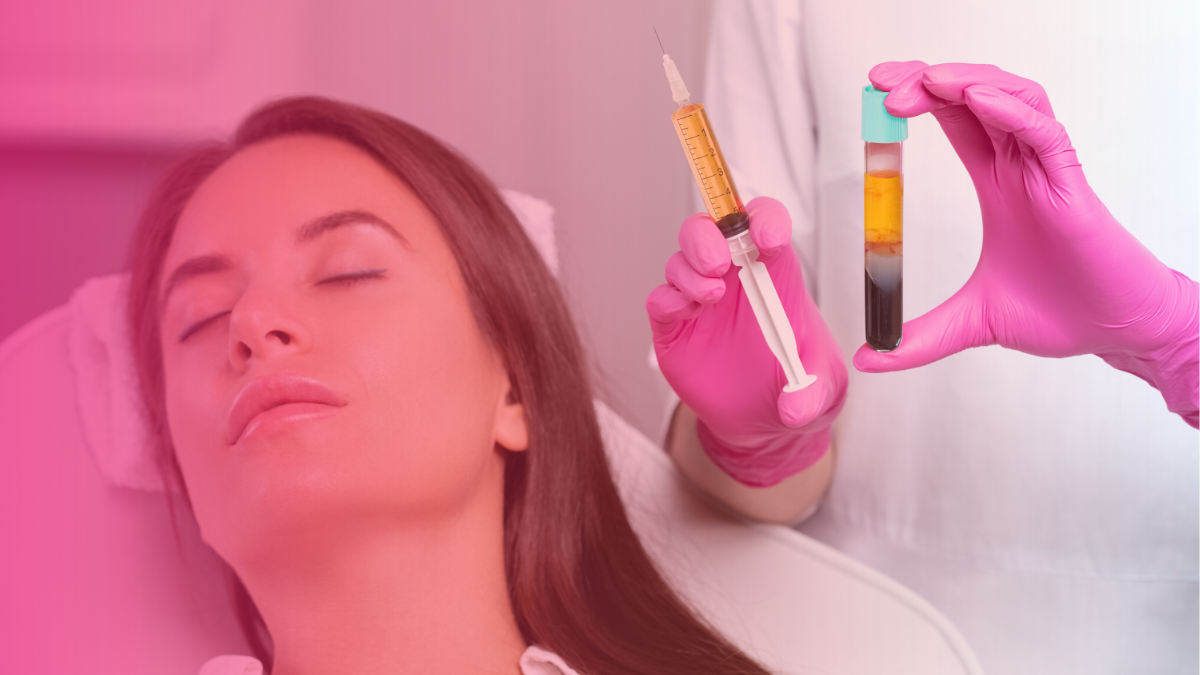
Under-eye hollows are one of the most common things people want treated, and also one of the riskiest places to inject. On the Get Clear Beauty Podcast, we talked with Julia of Let's Heal Your Skin in Staten Island, a practice she co-founded with her colleague, also named Julia. Both are clinicians with backgrounds spanning hospital medicine, critical care, urgent care, and private practice, and both still practice medically. As she put it, they are not aestheticians, they are clinicians, and knowing the anatomy is the point. Her favorite treatment for the under-eye area is PRF EZ Gel, and she explained why her practice will not place traditional filler there at all.
This article is informational and is not medical advice.
What PRF is, and how it differs from PRP
PRF stands for platelet-rich fibrin. Like PRP, it comes from your own blood, but Julia explained that it is processed differently. PRF is spun at a lower speed and contains platelets, white blood cells, fibrin, and growth factors, with no anticoagulants added. Because of that, it releases growth factors gradually over several days, which she said may support longer-lasting tissue regeneration than PRP.
Prices vary by location and provider.
The shorthand she uses with clients is that PRF is upgraded PRP.
What makes it EZ Gel
EZ Gel is made entirely from your own blood. The team prepares PRF, then gently heats and cools it, which produces a smooth, gel-like consistency. Combined with liquid PRF, it becomes injectable. The result is essentially albumin and PRF together.
The consistency resembles filler, but Julia was clear that it is not a filler. There is no synthetic material in it at all.
Why this practice will not put filler under your eyes
This was the most striking part of the conversation. The under-eye area has some of the thinnest skin on the body, and Julia described the specific risks of placing traditional filler there: vascular occlusion, bumps and lumps that may never resolve, and the bluish discoloration known as the Tyndall effect. Her practice does not offer under-eye filler for that reason.
She described EZ Gel as behaving differently because it is your own tissue. Swelling, puffiness, and lumps do happen, but they resolve, typically over two to three days. Because the material is autologous, if it did obstruct anything it is your own blood and reabsorbs into circulation. She also noted the risk of an allergic reaction is very low, since there is nothing in it that is not already yours.
Rather than simply occupying space, she explained, it integrates and works on the quality of the skin itself.
What it treats
Her favorite application is the under-eye area, where it fills hollows and stimulates your own collagen to rebuild. She said it also improves dark circles, though honestly: it softens them rather than erasing them, and genetics determine how much change is realistic. Some patients see dark circles largely disappear, and some will not.
Beyond the under-eyes, she uses it on cheeks, smile lines, fine lines around the mouth, temples, and hands, which she pointed out also reveal age. It suits people who want subtle volume alongside better skin quality.
On Sculptra, she does not treat EZ Gel as a replacement. She uses them hand in hand, and noted that some clients specifically want something entirely natural, which is when EZ Gel goes in on its own.
What a session actually involves
Two vials of blood are drawn, one processed for albumin and one for fibrin, each with a different spin. While one spins, another is heating or cooling. Julia was upfront that the preparation takes longer than the treatment: roughly twenty-five to thirty minutes, which is also when the injection sites are numbing.
The injection itself takes about five to seven minutes. They work through a single entry point with a cannula. She said patients feel pressure rather than pain, and described the discomfort as more psychological than physical, adding that she is squeamish herself and would not have it done otherwise.
The course, and how long results last
The protocol is three sessions spaced four to six weeks apart. Because the initial puffiness settles in a few days, you are ready for the next session by the time it does. She tells clients the final result appears four to six weeks after the last session.
Results last roughly six to eight months, with one maintenance session recommended at that interval, which works out to about once a year for many people. Lifestyle, metabolism, skincare, and genetics all shift that number. Her broader point was worth repeating: everything requires maintenance, and nothing lasts a lifetime.
Who is not a candidate
Anyone on blood thinners is a firm no, because the blood is too thin to carry the same factors. She also proceeds carefully with autoimmune conditions and with patients on steroids, and reviews full medical history and medications at consultation. She was direct that not everyone is a candidate, and that patients sometimes arrive expecting this treatment and leave with a different plan.
Pregnant and breastfeeding patients are not treated, and the reason is specific and worth knowing: the procedure itself uses your own blood, but the numbing cream contains ingredients that cannot be used, so they ask patients to wait.
If you take low-dose aspirin preventively, she asks patients to hold it for three days beforehand, unless it is prescribed for heart disease or another medical reason. The bruising risk is otherwise high enough to leave someone with black eyes for weeks.
The risks she does name are infection at the entry point, since needles are involved and the procedure is clean rather than sterile, possible bruising, and swelling, which she called guaranteed.
What it costs
Julia's practice prices EZ Gel as a package covering the three sessions rather than per individual treatment, with single-session pricing reserved for maintenance visits. Her reasoning is straightforward: a single session on its own wastes the client's money and everyone's time. They run new-client discounts and monthly promotions.
Compared with traditional filler, she said it runs slightly more expensive, while noting that her practice does not offer under-eye filler regardless.
If you already have under-eye filler
This is worth knowing before you book anywhere. Julia's practice will not inject over existing under-eye filler and will not dissolve it either. Patients are referred elsewhere to have it dissolved, then reassessed, and she noted some people need several rounds of dissolving before every pocket is gone. In some cases the skin has been stretched enough that a surgical option becomes the realistic answer instead.
What she wishes every patient knew
Her answer was that it is not one size fits all. If a friend had a treatment, that does not mean the same plan applies to you, and she said this is the hardest part of a consultation. Her practice offers a free consultation that includes a 3D skin analysis, and the results still differ person to person based on lifestyle, metabolism, and skin.
Thank you to Julia for such a clear and candid conversation. You can find Let's Heal Your Skin in Tottenville, Staten Island, at letshealyourskin.com, on Instagram at @letshealyourskin, and on Facebook.
If you are considering the treatment, compare real PRF EZ Gel prices from providers near you on our PRF EZ Gel price guide.
Compare Prf Ez Gel providers and estimated prices near you.
Prf Ez Gel cost guide →This article is for general education about aesthetic treatments and pricing. It is not medical advice and is not a substitute for a consultation with a licensed provider. Always confirm current pricing and suitability directly with a provider before booking.
New aesthetic treatment blogs every week, sent straight to your inbox.
Subscribe on Substack →
Comments
Comments are reviewed before they appear. For medical questions, please consult a licensed provider — we cannot give medical advice here.
Loading comments…